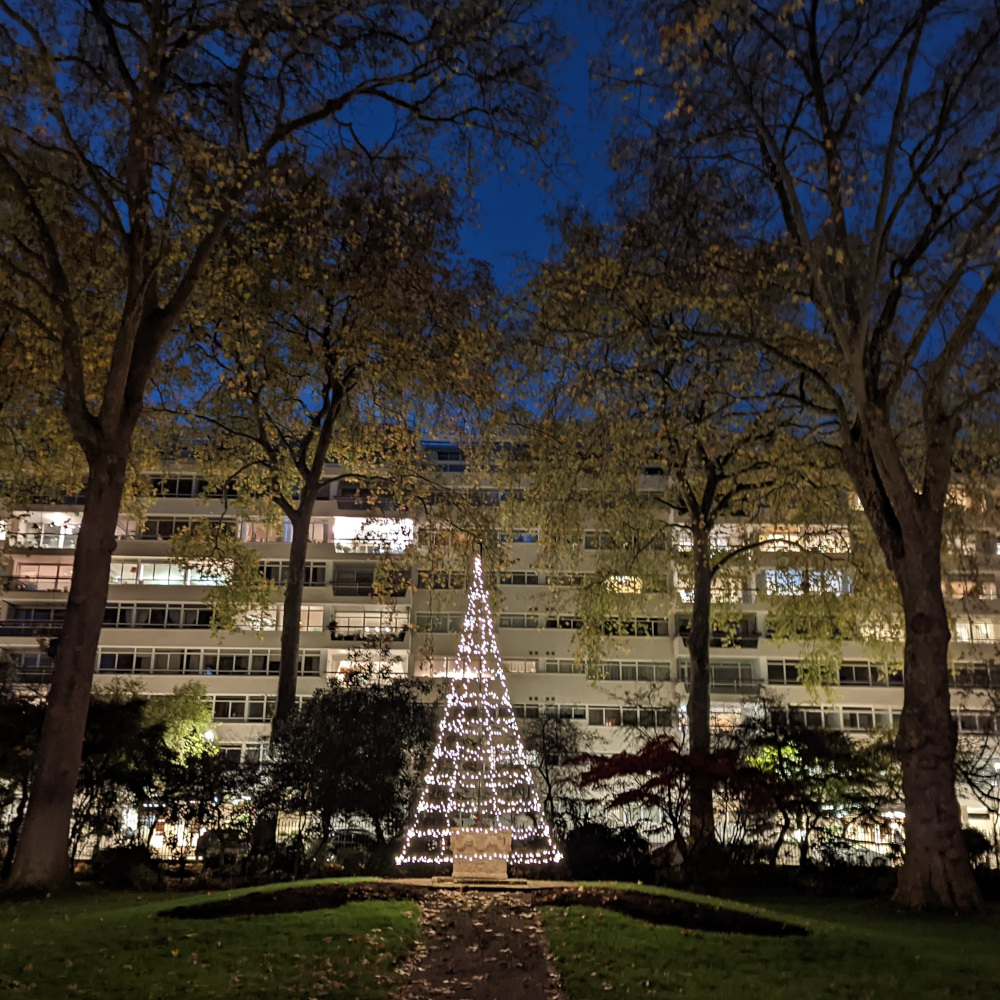
Heading into 2026 the Committee intends to repeat it’s 2025 policy of modest, rather than past-ambitious, enhancements. This year’s lean budget not only reflects the rapid changes made to the Garden over recent years (see 2023 Outgoing Committee Recap and News section for more), but also the ongoing constraint of operating such a large Garden in central London (1.6) acres, with so few ratepayers (116).
We will continue to try and deliver all projects for the best possible price, and ensure where we do make structural change, there is a clear business case both in terms of improving ratepayers benefit/use/utility of the Garden, and reducing our ongoing maintenance costs.
The Committee would like to thank ratepayers for their ongoing support in these endeavours.
Yours Sincerely,
The Gloucester Square Garden Committee
Jump to a specific section:
January - Planning & Removal of Christmas Lights
As usual the focus in January is leaf collection and removing seasonal decorations to Storage. This year the festive lights stayed up longer than planned due to staff shortages on the caretaking team.
Finalising planting plans has been particularly challenging owing to the looming risk of Thames Water imposing a Temporary Usage Ban (TUB / “Hospipe Ban). Whilst the Garden would most-likely have been permitted to continue using its drip pipes and watering newly planted trees during a TUB, any newly planted plants and shrubs would have struggled. The persistent wet weather at the start of 2026 has reduced the risk of a TUB, albeit bringing its only challenges with regards to a perched water table in the square.
Recognising the need for greater organisation (to react to planting windows faster), in Q4 of last year, Committee volunteers began on thoroughly documenting the Garden and its beds, as part of a knowledge management system that will hopefully allow future committees and their agents to get up to speed quickly with the Garden. This master plan is being used to drive this year’s perennial planting cycle, which we hope to undertake in March (weather allowing) before the Plane Tree canopy comes in.
The new bedding masterplan, splits the garden into 65 beds, documenting sun profiles, colour schemes and regional/variety focuses. It also documents where certain perennial varieties have struggled to try and identify common threats/weaknesses.
February - Plant Orders & Water Line Investigation
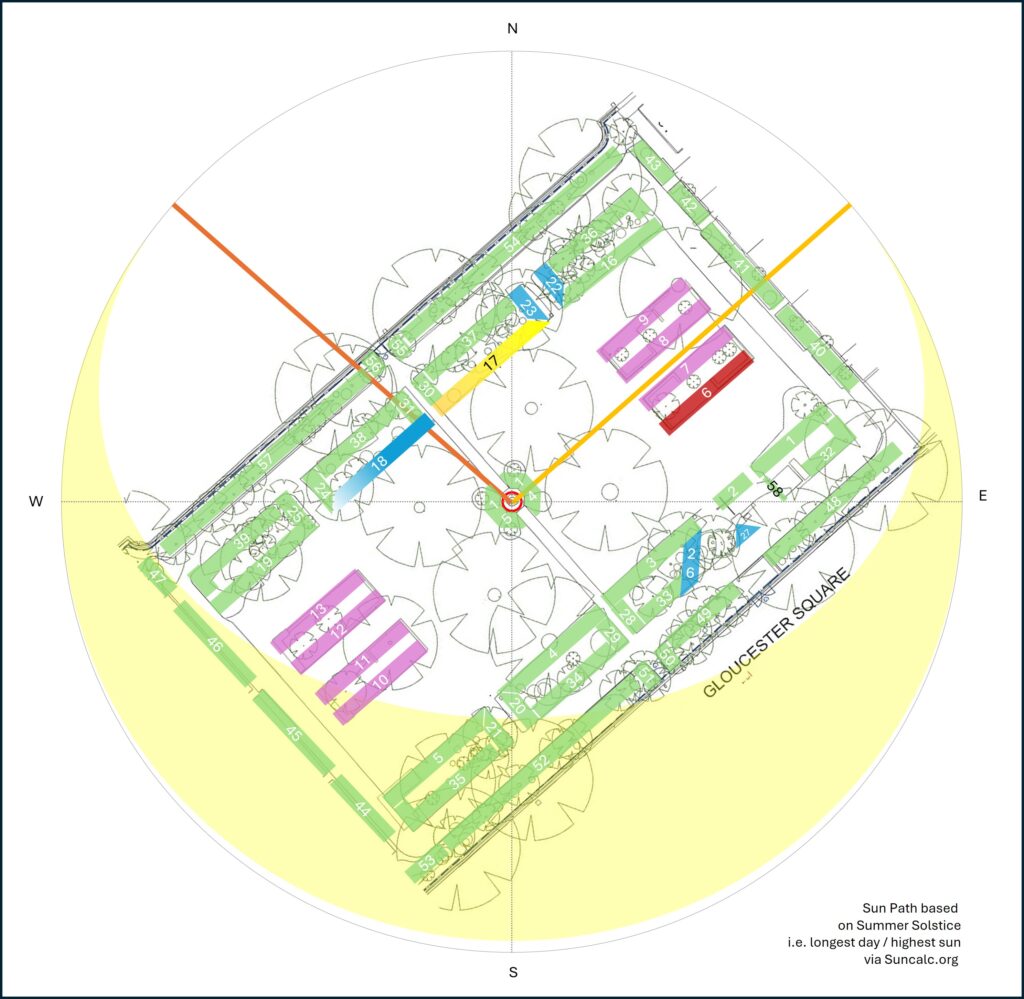
22 beds have been identified for new plant investment in 2026, with budget allocation being determined by the investment priority (medium / high / critical) and area requiring new plants. As with last year the Garden Committee will leverage the trade memberships of a Committee member to order the plants directly at wholesale prices, the Garden Caretaking team will then support our Contract Gardeners in planting the delivered plants to as high a standard as possible.
The Bedding Master Plan should allow for much greater oversight and consistency going forward, ensuring that all beds recceive a suitable level of attention, and lessons are learnt from any past failed investments.
Having tried soil-enrichment focussed initiatives over the last 3 years,
the Committee will this year emulate some Gardens in Notting Hill which
follow a more aggressive cycle of plant feeding (with impressive
results). Soluable plant food will be sprayed fortnightly to all suitable beds by the Gardeners / Garden Caretaking team from late-Easter to mid-Summer.
To help facilitate this work, the Garden caretaking team are exploring installing an additional tap location on the North side of the Garden. Whilst there is a tap location in the west central bed, and an above-ground pipe-join in the east central bed, these locations are considered poor locations for taps (too much risk from missue, an too much disturbance to ratepayers trying to enjoy the garden). To install a tap location along the North path, the caretaking team intend to perform investigative works in March to trace the route of historic metal pipes under the Garden, and find a good location to join onto the historic pioes.
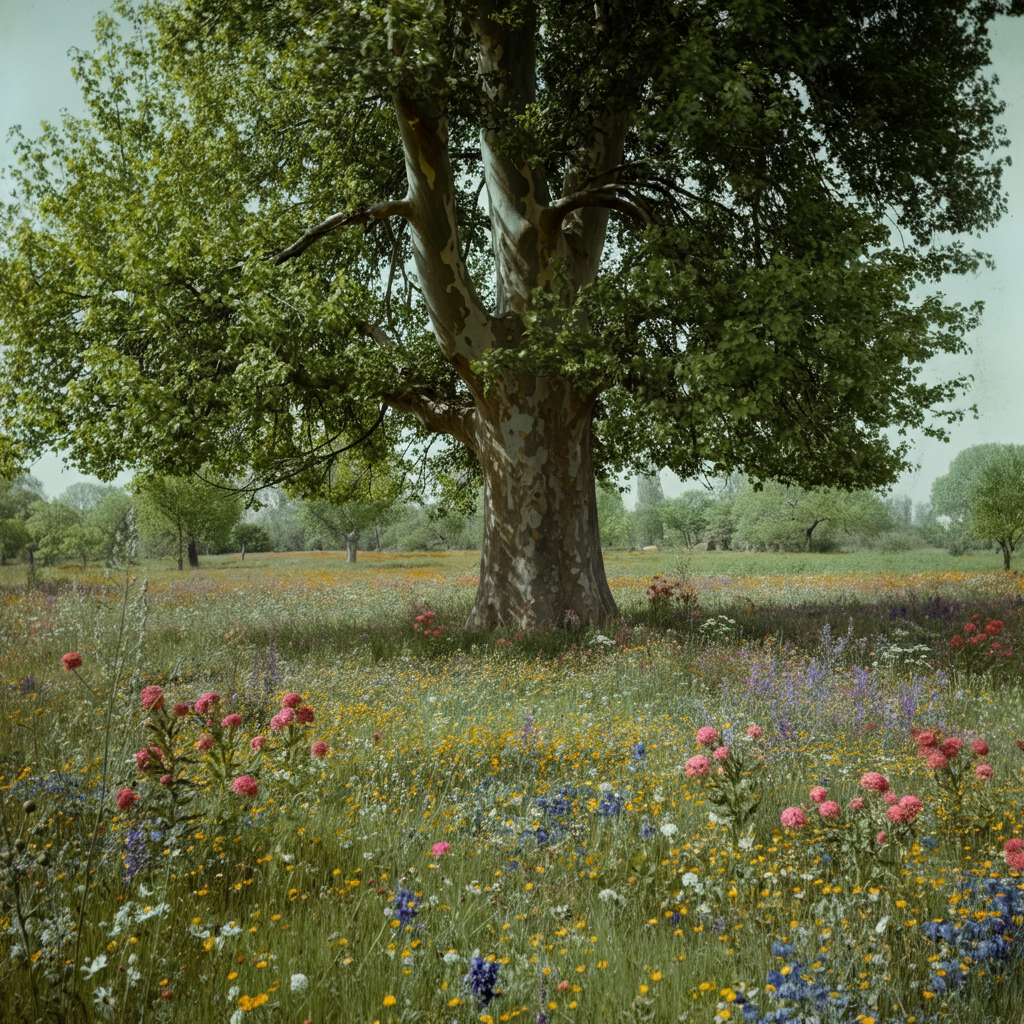
Seperately, there will be a modest investment to plug underestablished sections of the wildflower tree rings, specifically either side of the Plane Tree nearest the playground, where sections of Birdsfoot Trefoil, Red Clover and Wild Primrose have failed.
Finally, the Garden is making some small investments in wildlife (after highly successfull initatives in 2022-25).
Whilst the garden’s bird feeders are squirrel resistant (placed in jump-proof locations, under baffles), and have successfully boosted the Garden’s population of native song birds, parakeets remain an issue. Whilst they don’t appear to deter smaller birds (thankfully), Parakeets have proved messy eaters, using their beeks to rake out the seeds they dont like from the feeders to get to the seeds they want. The seeds then drop to the ground where they are grazed on by Pigeons. To try and deter Parakeets/pigeons, and reduce bird-feed costs, the Committee are trialing a more expensive weight-balanced feeder that should close if landed on by Parakeets.
Other wildlife initatives (such as boosting butterly/moth populations) represent primarily voluntary-time-contributions from the Committee and should come at no added cost to the ratepayer.
March - Planting and Irrigation Upgrades
As mentioned, it is the Committee’s intention to get all perrenials planted by mid-March. This is typically the best time to plant as the Plane Tree canopy hasnt come in, and the Plane Tree trichrome-drop is still months away. Planting later than mid-march means plants are trying to grow/establish with less sunlight, and risking damage from the Trichrome collection (and usual spring activities such as football).
If sourced in time, the Garden will seek to plant two replacement trees for previously felled dead/permanently-declining trees. The first will be a new Wattle tree to replace the felled cherry adjacent to the north-most seating area (best planted March – May). The second will a Northern Catalpa as a like-for-like replacement of the much cherished though rapidly declining and dangerous, toppled Catalpa, felled in 2024 (best planted Mid-November – Late March). These replacements were sought in 2025 though we were unable to source suitable specimens. Efforts have been doubled to source these specific trees in 2026, delivery will be coordinated with ideal planting windows (noted above).
We hope that the irrigation system, which undoubtedly is the to Garden’s benefit, though required substantial investment during the 2010s, will finally start living up to its potential in 2026. Over the last 4 years substantial effort has been made to document the system, remove superfluous hardware, and train the gardeners and garden caretakers in how to control and maintain all aspects of irrigation.
The last problem that remains is blow outs along the drip pipes. Drip pipes are invaluable as unlike pop-up sprayers, they are approved for ongoing use during a Hosepipe ban, however they are vulnerable to blowouts whereby pipes split, or connectors are pulled apart. Such blow outs cause large volumes of water to flow out into the bed from the irrigation tanks, not only damaging that bed, but also causing the irrigation system to run-out-of water before it reaches the following beds.
This challenge is compounded by just how poor most Irrigation Controllers on the market are.
- They typical only allow up to 6 programmes , and do not allow for zones to be run in anything other than a sequential numeric basis (the order they are wired into the controller).
- The Garden has 22 zones, and the existing controller only allows programmes (meaning each programme must run 5-6 zones each)
- Under the existing controller, the higher-numbered drip pipe zones (forced to run later in any given programme) frequently do not receive enough water owing to blowouts
April - Furniture and Electric Equipment Review
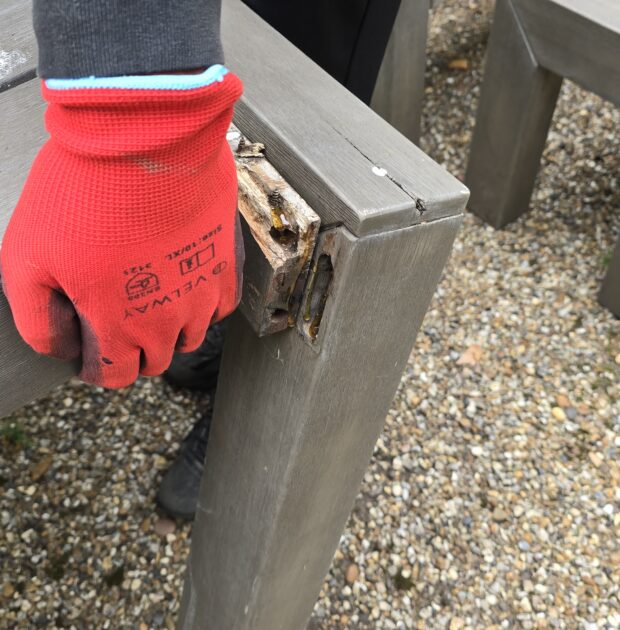
The rectangular tables between the central beds at either end of the Garden have been popular since they were installed in 2022 (dedicated post here). In particular, residents seem to appreciate the ability to use the tables for events, as they can be moved to locations in the Garden where the events are being hosted and accomodate lots of people.
Unfortunately, that constant movement has proven a bit too much for the tables, which both broke in August last year, and could not be repeaired until early September. The repairs are seen as temporary, and the Committee will need to assess the tables’ condition over the Easter period before deciding whether replacement is warranted. If the tables are replaced, the Committee will endeavour to source more robust units (without sacrficing visual suitability) that will last for more than 3 years.
The end of spring also brings with it the resumption of mowing on the square. Per its published Noise Policy, the Committee continue to review Electric Mowers coming to market that share the same Stihl AP battery platform which supports our new (extremely quiet) electric leafblower and other battery-gardening tools.
As things stand, no electric mower using this battery platform comes with a rear roller for striping the grass, which is why we have held off in investing in such equipment (through our contract gardeners) – as residents are thought to like the striped lawn asthetic. If further noise complaints are recieved regarding the Electric Mower, the committee will reconsider this posiition.
May - Path Clearing and Gap Filling
The long and storied path of the Gardens paths can be found on the dedicated Path Clearing page of this website.
To recap – some 90m of path along the Southern perimerter of the Garden was cleared in 2024, this was a prerequisit of the playground works (to match the underlying path height to the playgrounds bonded-mulch surfacing), though has proven a godsend in subsequent winters as the path is mud-free and easy to maintain.
Works were tentatively planned to clear the North path in 2025 though could not proceed due to budgetary constraints. At the same time, the costs and logistical challenge of disposing of the Gravel and Muck combination has significantly increased as skip/aggregate firms have closed, simplified services, or retreated from central London. Much of this is down to economic circumstance (construction work in central London falling siginifcantly), though external factors like LEZ, ULEZ, and Congestion Charge costs have taken there toll.
In late 2024 the Garden was paying c.£262 to fill a 6-yard skip, as of 2026 that price has risen some 26% to £330. Worse still, fewer companies than ever are offering 6-yard skips that can fit within the Garden’s compound, prefering larger 8-yard skips which is the maxiumum size permissable under a stanard on-street skip lisence for most London Boroughs.
The Committee are currently looking at options for brining down the cost of waste removal, with the leading candidate being to board out half of the Garden Compound, fill this with the gravel-and-muck combination, then have it removed by a grab-lorry. This would however, constratin space-in and use-of the compound for other gardening operations, for an extended period.
Another option would be using a Trommel / Rotarry soil sieve to seperate the soil from the gravel, moving the soil back to the beds and relaying or dispoising of the gravel. The Committee are looking at options to hire a suitable trommel to test this option, though suspect the labour costs will vastly exceed the waste-away costs of other methods.
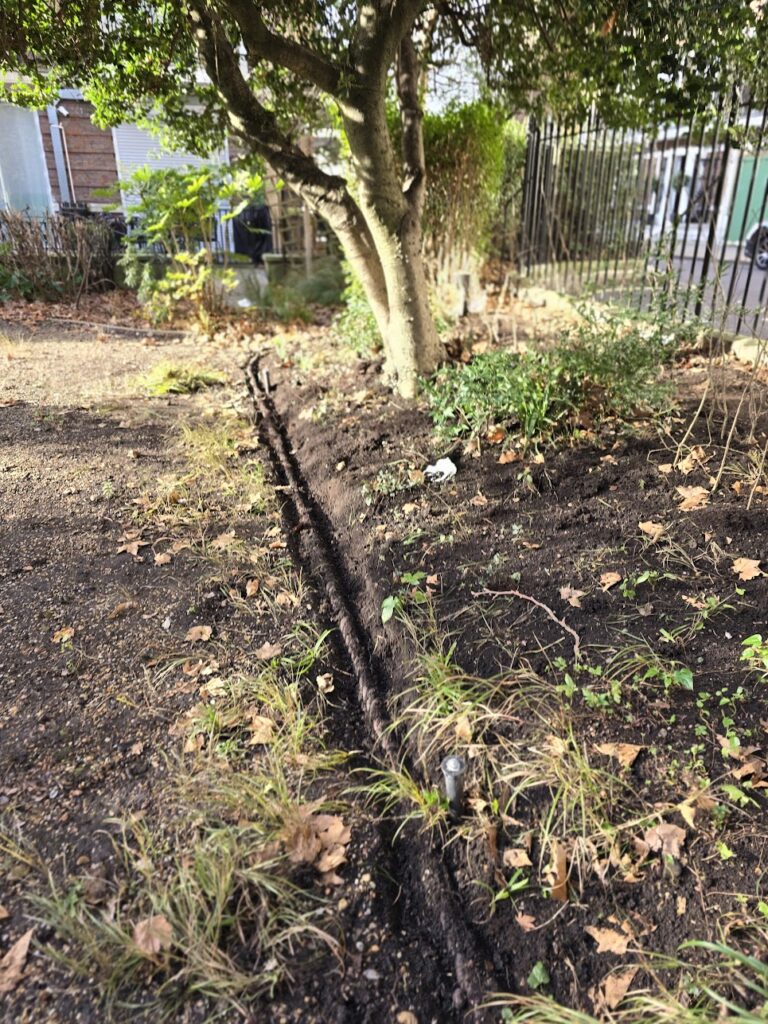
EIther way the intention is to clear the North path of the hard-packed mud and muck during 2026.
June - Open Days

In 2024 we joined the London Open Gardens Event for the first time in over a decade. Our Garden was one of the more popular Gardens among the 100+ participating, with 300 visitors touring Gloucester Square. Last year we enrolled in the London Open Gardens once again, and too our pleasant surprise, drew a similar number of guests to the year before.
In 2026 we will be continuing our participation in the London Open Gardens event, this time on Sunday June 7th between 10am – 5pm.
Any resident-volunteers to man the welcome desk would be particularly appreciated. Volunteers recieve a complimentary London Open Gardens ticket to explore other Garden Squares around London.
A note on unapproved events and unaccompanied use of the garden by non-occupiers (i.e. not ratepayers or their assured tenants):
Unfortunately our 2024 Open Gardens weekend was detracted-from by both an unapproved resident event on the preparation day, and an unapproved non-resident event on the afternoon of the Open Garden Day itself (where the event hosts claimed to be family members of a resident who would be attending imminently, a manifest falsehood).
Whilst the committee have issued fines in both cases, and a final warning to the keyholder responsible for the latter event, we want to be clear that any unapproved events attempted in the days prior-to or during the Open Garden weekend will be immediately shutdown, and run a high risk of ratepayer suspensions / fines. Per the Rules and Events sections of this website (also signposted in the garden) any gathering of 15 or more people (18 months old or older) is considered an event and requires the advanced permission of the Committee.
Residents are also reminded that use of the garden is strictly for Occupiers (a defined term under the Estate Management Scheme / Leases, broadly meaning the ratepayer or their assured Tenant) and their accompanied guests. Facilitating the unaccompanied use of the Garden by non-occupiers (with no contractual right to use, nor paying for, the garden) is not only a breach of contract, but could fall foul of Section 11 of the Fraud Act (2006): Obtaining Services Dishonestly.
July - Some Peace and Quiet
—
August - Nutrient Recylcing Facilities
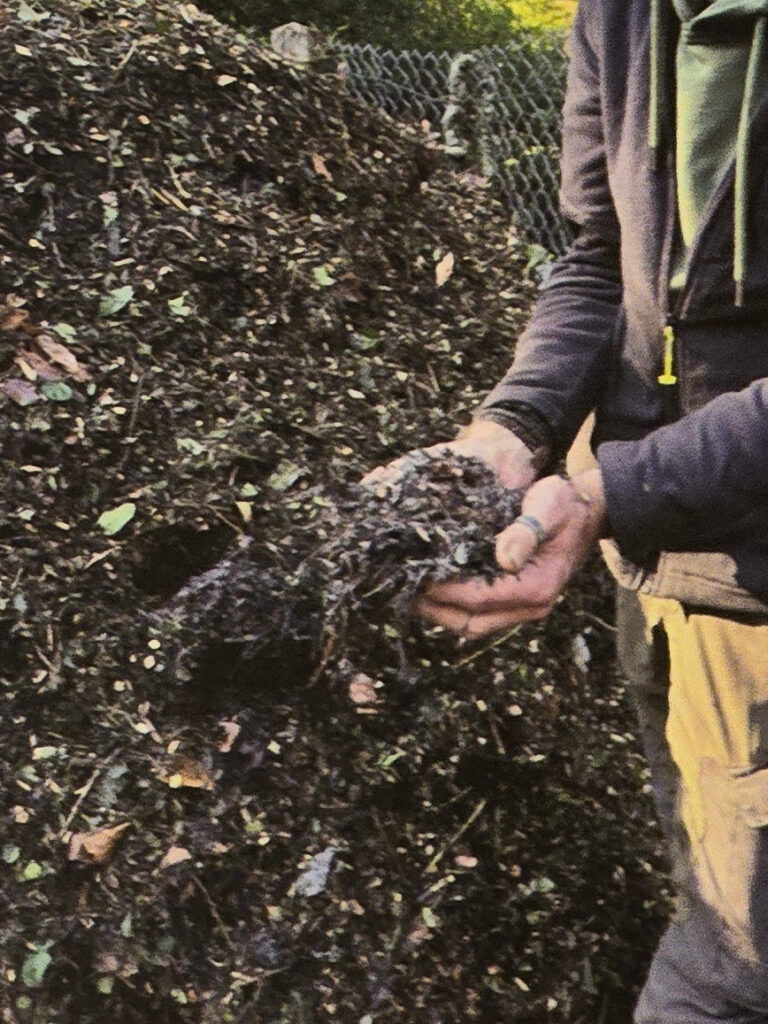
Ladbroke Square Leaf Mulch – © Garden Square News, Fall 2024
This is an ongoing issue that was parked due to noise concerns in 2025. As we mentioned in the 2025 plan, there is a lot to be said for a well executed leaf mulching plan – such as that run by Larbroke Square’s head gardener, Nevil Capldi – covered on Pg 12 of the Autumn 2024 issue of Garden Square News.
As Nevil eludes-to in the article – a lot of squares get leaf-mulching wrong, especially with regards to the primary source of leaves – Plane Trees. These leaves are large, thick and resistent to decomposing. Piling them up as they fall simply creates a pile of leaves that fail to decompose, and attract insects/vermin.
The solution is to blend the leaves before attempting to mulch them. This not only significantly reduces the volume of leaves (up to 10-to-1 reduction), it also greatly speeds up the decomposition of the Plane Tree leaves, and reduces the propensity for vemin to nest in the pile.
If done correctly, mulching a significant proportion of the gardens leaves would provide us with c.3,000 litres of leaf mulch ready for each spring. That would go a long way to arresting the annual decline in soil nutrients that we are currently experiencing, and allow us to reduce and eventually perhaps even eliminating the cost of buying-in the make-up nutrients.
Locations for (non-permanent) Leaf Mulching bins around the Garden are currently being reviewed, as is the ability to purchase an electric leaf mulching machine capable of handling the volume of Plane Tree Leaves we experience, without producing excess noise and dust.
September/October - Bulb Planting and Leaf Collection
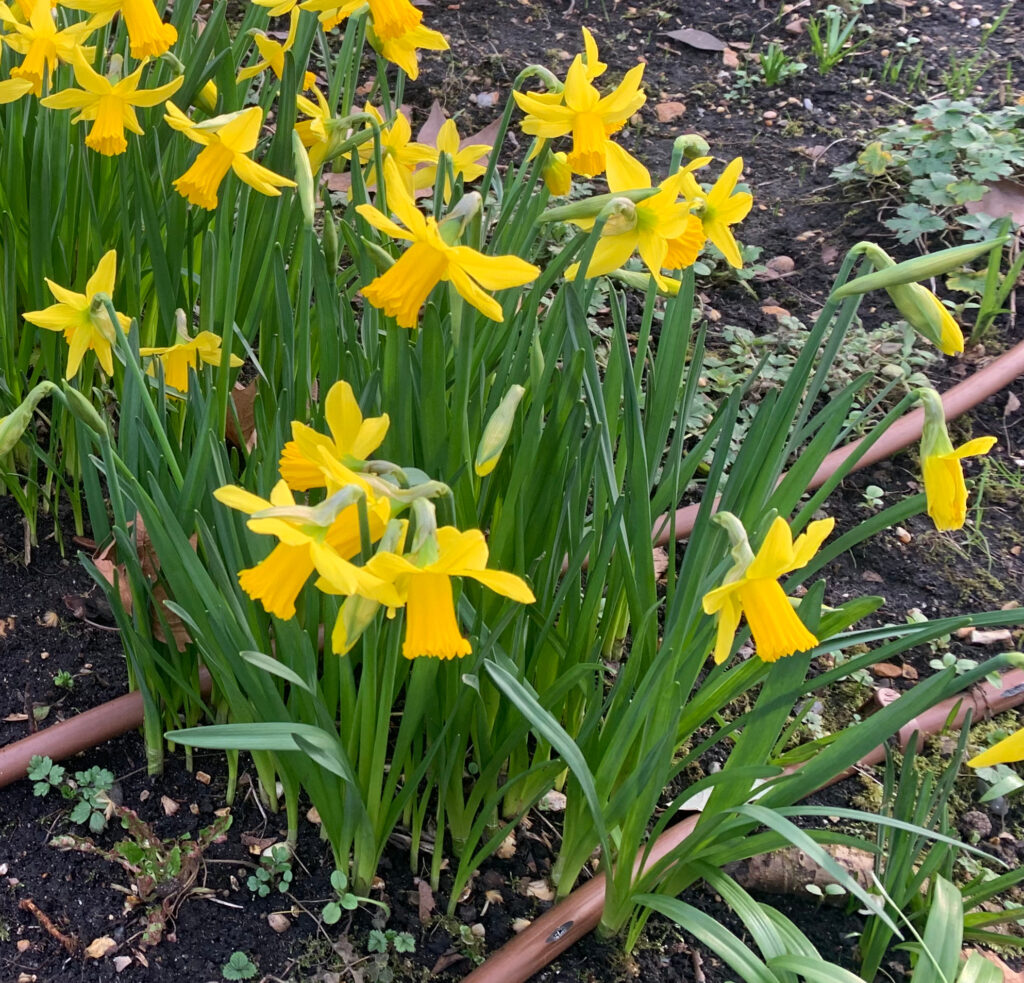
As we move into the fall the focus of the Gardeners and Caretakers will be planting for the following spring, this will mainly be focused on bulbs around the trees and in the central bed. We will not be removing and storring bulbs between seasons as it is not economically sensible given the labour costs. Instead bulbs will be replaced on a bed-by-bed basis where they thin out over time. Details of any bulbs planted will be added to the Bedding Master plan.
To free up Gardener and Garden Caretaker time, we will be continuing the successful policy of reducing leafblowing during the winter, especially during good weather, where we focus energies on horticulture rather than maintaining a neurotically-tidy space.
Leaves are only collected from the lawn (where they might cause browning), and (albeit less frequently) from the path. Leaves falling in the flowerbeds are cleared from the edge of the bed (where they might smother/kill retreating perenials), though left towards the center of the bed.
November/December - Festive Lights

In November we will be focusising efforts on preparing the Garden for our seasonal Festive Light display.
The central flagpole tree, which has drawn much positive feedback from residents, is starting to show signs of its age. The Committee will likely need to purchase a replacement light-set this year, though will be able to benefit from the trade-discount a Committee member enjoys with Fairybell to secure an improved, easier-to-repair replacement at a significant discount.