
Residents: Sign-up for exclusive content
Sign in
This page seeks to explain the Committee’s current policy with regards to noise generated from Garden Operations, with a particular focus on leaf blowing. Our objective is to minimise the noise impact of Garden Operations — first and foremost on our Gardening team, who work closest to the tools, but also on our neighbours (ratepayers and otherwise).
The current policy builds on efforts and learning over the last 3 years with our current Contract Gardeners, Gravitas Gardens.
2025 has seen demonstrable improvements in the capability of Electric Gardening Equipment coming to market, including the first Backpack Leaf blower to match the performance of industry leading petrol models. Better still, the 2025 range of high-end electric backpack blowers from Stihl use large-radius fan wheels rather than compact turbines (found in near all other battery models), so do not emit the same high-pitched/shrill/loud noise associated with other electric models, despite being far more powerful.
In light of some resident complaints regarding Leaf Blowing noise, the Committee has accelerated plans to move to an all electric fleet of Gardening tools. Specifically, we have worked with our Contract Gardeners to secure a new range-topping electric Leaf blower that generates significantly less noise than their existing petrol and electric-handheld models.
The new Electric Backpack Blower has been used onsite since November 20th 2025, and it is expected all leaf/trichome collection will be performed by this new blower (combined with smaller, handheld electric blowers where neccessitated) unless adverse weather forces the use of non-electric tools. This will not only singificantly reduce noise in the fall, though also during the Plane Tree Trichrome drop each April – May.
As to why such machinery is required; there a lot of misconceptions regarding the practicalities of Garden Operations, governing statute regarding safe working, and microenvironment realities of a Central London Square, which can lead to unrealistic expectations (such as using no machinery or ignoring seasonal change and leaving leaves/trichromes on the ground). This policy attempts to explain the challenges, and the Committee’s reasonable response to them.
It is worth noting that between the Garden’s Managing Agent, our Contract Gardeners, and Committee Volunteers, the Committee as a whole are afforded an intricate understanding of the operations at over 3 dozen other Garden Squares in Central London. The Committee continues to benchmark Gloucester Square against its peers, hoping not only to set the best policies, but also communicate them transparently.

We would hope all residents appreciate that no Gardener has a particular predisposition to strap a petrol engine to their back, and spend many hours a week in such close proximity to the noise, not to mention breathing in poorly filtered exhaust particulates.
They do so, because it is comparatively safer to their health (vs detrimental repetitive movements contrary to statute), and the only practical way to move significant amounts of material, without damaging lawns / flowerbeds / paths, in a time-effective, and therefore cost effective way. We will explain why clearing is critical in the next section.
Flowerbeds can’t be effectively cleared of leaves with brushes or rakes. It would lead to excessive plant death, and create compounding issues with weed growth. Gloucester Square’s layout is impractical, with over 1 linear-kilometer of flowerbeds, on average 3m depth (over 3,000 SQM of delicate bedding).
Over the last few decades, Gloucester Square’s paths were covered in decorative gravel, which has become a mud-gravel mix over time due to decomposing material. The Committee are currently in a process of removing this gravel – further details on the dedicated page – but only on the cleared sections of path along the Southern length of road is Sweeping a realistic, and utilised alternative to blowing. Sweeping the gravel paths would pile gravel and leaves together, and flick yet more pesky gravel into the flowerbeds. Clearing must occur to stop further muck decomposing and mixing with the Gravel.
Lawns could hypothetically be hand-raked, though the sheer area (circa 0.75 acres) would be extremely time consuming, represent excessive manual operation and repetitive physical movement. Repetitive is a key issue with excessive manual raking, as the motion (pulling towards the body on one side or another) is extremely repetitive compared to other physical labour such as digging or sweeping where the motion can be varied on each go. Sweeping the Lawn would be highly damaging.
The Manual Handling Operations Regulations 1992 (MHOR) suggests such works should be avoided where reasonable alternatives exist, such as leaf blowers. This is reinforced by accompanying guidance by the Health and Safety Executive, that highlights repetitive physical movements are a recognised factor in musculoskeletal disorders, and recommends avoidance or frankly burdensome mitigation strategies (limited working periods, adequate rest breaks, etc).
For both the paths and the Lawn, wheeled Leaf Vacuums would offer a slightly lower operating noise level than leaf blowers, though could not be used universally in the Garden (as the beds would still need to be blown). We continue to keep an eye on developments in this space.
London Squares have significant amounts of material to remove or reuse each year, highly correlated to their number of London Plane Trees.
The first issue is the Trichomes dropped by Plane Trees between Easter and Summer each year. Whilst studies are limited, each of Gloucester Square’s c.200 year old Plane Trees are thought to drop 1-3billion hairs (clumped together). These hairs are highly unpleasant, as they feature small hooks that get lodged in one’s throat. Blowing the trichomes as soon as they fall in clumps (before the individual hairs detach) is the most effective way of removing the problem. Raking and Sweeping is extremely ineffective.
The second issue is leaf-fall. An established, 200 year old Plane Tree will drop roughly 100 thousand leaves each fall, enough to cover half an acre. Gloucester Square’s 14 Plane Trees therefore drop roughly 7 acres of leaves a year.
Residents are encouraged to examine one of the leaves dropped by our Plane trees. They are wide (15-25cm across), thick, robust and slow to breakdown. More scientifically they have a high lignin and wax content, but a low nitrogen content, making them highly resistant to microbial breakdown.
This means when they fall on surfaces they have a smothering and wet sheet effect. Because there is a far greater area of leaves in the Plane Tree, than ground beneath it, they form a thick layer that blocks sunlight, traps moisture, blocks oxygen and prevents wider gas exchange. This is damaging to the Lawn and Perennial Plants in particular.
It’s worth noting the Garden has dozens of additional deciduous trees dropping leaves in the Fall, but because these smaller more useful leaves mix with the predominant Plane Tree Leaves, they must be collected as one and the same. The question then becomes what to do with them.
Because of their resistance to Decomposition, Plane Tree Leaves can only be mulched if they are first blended down and mixed with nitrogen (imported fertilisers or grass clippings, etc), even then, they can take 18 months to decompose into a suitable nutrifying leaf mulch. Whilst the Blending process would reduce the volume of the collected leaves by 90%, it could potentially create additional noise in the Garden, and release the particles successfully trapped by the leaves during their lifespan.
So is it worth Mulching Plane Tree Leaves? The Committee are continuing to assess the matter, and might conduct low-expense trials in 2026.
The noise and particle release issues are particularly problematic given it would occur at one static point in the garden, disproportionately impacting a subset of ratepayers. The nutrient benefit is also questionable. Plane Tree leaves have a high tannin & polyphenol content, making them slightly acidic, and temporarily inhibitive of microbial activity and earthworm feeding. The aforementioned low nitrogen content of the Plane Tree leaves means they do little to address a nitrogen shortage in the wider garden.
Until such time as a leaf-mulching process is in place, the only option is removal by the van-full, which is the current policy. Each year the garden removes all dropped plane tree leaves for third-party disposal/reuse, a process managed by our Contract Gardeners. Gardening Operations have to be coordinated to gather, collect (in the garden compound) and remove leaves as effectively as possible during the fall, and are timed to maximise the efficiency of van-collection.
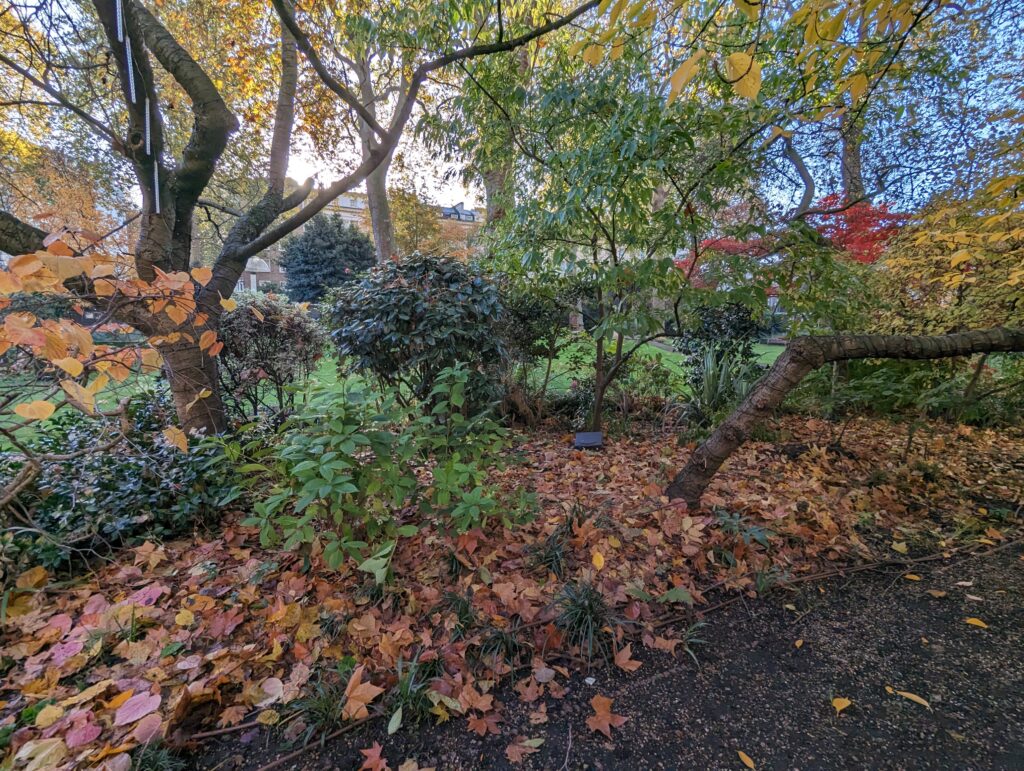

As mentioned, the Garden is currently looking to move all regularly used Gardening Power Tools / Machinery towards electric models with on a single battery platform (to reduce cost-requirement on our Contract Gardeners for additional high-amp-hour batteries and fast-chargers). The leaf-blowing equipment has mandated the Garden move to the Stihl AP battery equipment, so all future Electric Machinery must share this platform.
The garden is keeping our approach to mowing under constant review between now and next Summer. At present the Electric Mowers powered by the Stihl AP battery range do not feature a roller for striping the lawn. We will keep monitoring Stihl announcements between now and Spring 2026 in the hope that such a mower will be released, though until such a time, the Garden’s intention is to continue with a petrol mower.
The Garden performs tree inspections twice a year, that may include the cutting-away of deadwood and processing any removed material through a woodchipper. Due to the requirements of the task, and their mobility, Tree Surgeons do not use electric equipment, and even such tools were available, the Garden does not represent a significant enough client for any tree surgeon to mandate the use of such equipment. As such, residents should expect these works, occurring roughly twice a year, to continue using petrol equipment. Clearly the noise generated from such works is more ad-hoc than that associated with leaf-blowing or mowing.
It should be noted that the expensive electrical equipment being invested in by our Contract Gardeners, to the benefit of residents, is typically only carriers an IP X4 weather-resistance rating, or “splash resistant” in layperson’s terminology.
There are no suitable Electrical Tools currently on the market that advise operation in consistent rain. Our (the committee + Gardener’s) intention is to work around this by carrying-out other important gardening activities during periods of wet weather. The committee recognise this is an inverse to a traditional gardening approach, where leaf-blowing on very wet days is seen as preferable to working the soil, though appreciate the Gardening team’s cooperation.
However, it should be noted that during extended periods of wet weather coinciding with agreed gardening days, it might be necessary to deploy petrol-driven equipment simply to undertake critical clearing tasks in a reasonably-timely manner. The Committee hope to avoid such exceptions wherever possible, and will keep the policy under strict review.


We have already spoken to our ongoing effort to reduce the noise generated by Gardening Operations through use of the latest electric tools, though we also do our best to reduce noise during unsocial hours; we do this despite the long-running trend of there being at least one major construction project around the Square at any giving time (generating noise every available hour).
Whilst the Garden Committee reserve the right to operate as required anytime within the Westminster standard working hours (Monday-Friday, 8am to 6pm, and Saturday, 8am-1pm) in practice we try try and keep all noisy work to more sociable hours, including not starting mowing in the summer until 10am or later, and finishing by 5pm.
Leaf and Trichome collection frequently requires the Gardeners to attend for a half-day and full-day each week. For the half days it in not possible for the Gardeners to attend in the middle of the day, so noisy works may start as early as 8:30am, but will finish by midday in those instances.
To show maximum consideration to residents, Gardeners are asked wherever possible to perform works in such a sequence so that they avoid working in close proximity to any residence during early/late hours.
For example, if starting work early in the morning, the Gardeners have been asked to work from the inside of the Garden, outwards, so that they only generate noise near the properties bordering the square towards the middle of the day. If the Gardeners start work in the middle of the day, the approach is reversed, to avoid noise imposed on these properties late in the afternoon.
Residents are reminded they have no contractual right to instruct the Gardeners directly as to how to undertake their work, regardless of strength of opinion, length of residence, or horticultural expertise. Only current, duly elected members of the Garden Committee appointed to the Gardening Subcommittee, and their appointed managing agent, may give instructions to the Gardening team. Residents taking umbrage with the approach of Gardening Operations must Contact the Committee or Report the Issue via this website, and are not to challenge the Gardeners directly.
Sign up to receive latest news and events directly to your inbox.
© 2022 Gloucester Square, supported by 48-49, 47, 44-46, 26-28, 13-14 Gloucester Square and 21 Hyde Park Square